Lithium batteries now power electric vehicles, tools, backup systems, and household storage. The International Energy Agency’s Global EV Outlook 2024 estimated that energy-sector battery demand reached about 750 GWh in 2023, driven largely by electric vehicles. Its 2022 analysis also identified China as a major hub for battery-cell and component manufacturing. Those figures explain the interest in learning to build your own lithium battery pack—but scale does not make a home-built pack simple.
This guide presents ten practical considerations, from choosing compatible cells and calculating capacity to selecting a battery management system, fuses, wiring, and an enclosure. A loose connection can heat up. A mismatched cell group can age unevenly. Small details matter. Reliable work starts with verified cell specifications, careful assembly, and checks suited to the pack’s design. Follow manufacturer instructions, use appropriate protective equipment, and seek qualified help when testing or handling uncertain components. Lithium batteries can cause fires or serious injury if damaged, incorrectly assembled, or charged improperly.
The steps here are educational, not a substitute for engineering review or applicable safety requirements. A tidy layout is not proof of a safe pack; that is worth remembering. Before building, confirm that the cells, charger, BMS, and intended load are compatible. The ten approaches below offer a structured starting point, while leaving room for an honest question: is a DIY pack the right choice for this project at all?
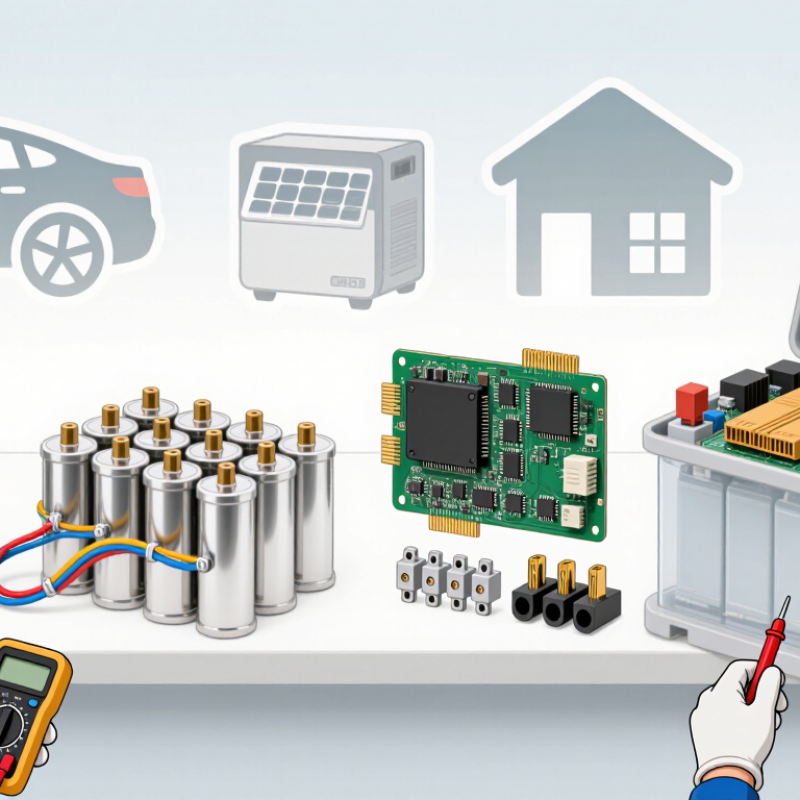
Lithium battery packs differ in chemistry, cell format, and intended use. These choices affect energy, weight, lifespan, and safety. Lithium iron phosphate packs are often selected for stationary storage and some low-speed vehicles. They typically offer long cycle life and good thermal stability, but store less energy per unit of weight than many nickel-rich alternatives. Nickel manganese cobalt cells can suit applications where compact size and higher energy density matter, such as portable equipment. They need careful temperature control. Lithium titanate cells can support frequent cycling and rapid charging, though their lower energy density limits some uses.
Cell shape is another consideration. Cylindrical cells are sturdy and easier to handle individually. Prismatic cells can use enclosure space efficiently. Pouch cells are lightweight and flexible in shape, but need suitable mechanical support. These are formats, not chemistries. The distinction is easy to miss.
A pack for a home backup system has different priorities from one for a handheld tool. Backup storage may favor service life and predictable operation; portable devices usually value low weight and compact dimensions. A battery management system monitors cell voltage and temperature, while fuses and sound insulation help address faults and vibration. Match the pack to its real operating conditions, not just its advertised capacity. A tidy specification sheet cannot replace professional design review, compatible cells, and verified protection. Details matter.
| Pack Type | Typical Configuration | Nominal Voltage | Common Applications | Key Characteristics | Important Design Considerations |
|---|---|---|---|---|---|
| Single-cell portable pack | 1S lithium-ion | About 3.6–3.7 V | Small electronics, sensors, and compact portable devices | Simple, low-voltage format suited to devices designed for one cell. | Use a cell and protection circuit specified for the device; charging limits depend on the cell chemistry and datasheet. |
| Compact multi-cell lithium-ion pack | 2S or 3S lithium-ion | About 7.2–7.4 V (2S) or 10.8–11.1 V (3S) | Portable equipment, small robotics, and selected power tools | Series-connected cells raise pack voltage while capacity in amp-hours remains that of one parallel group. | Cells in each series group need compatible specifications and monitoring; use a suitable multi-cell battery management system (BMS). |
| 12 V-class lithium-ion pack | 3S lithium-ion | About 10.8–11.1 V | Portable equipment designed for a three-cell lithium-ion supply | Often described as a 12 V-class pack, although its nominal voltage is below 12 V. | Confirm the equipment’s allowable voltage range and use a charger designed for the selected chemistry and series count. |
| 12 V-class lithium iron phosphate pack | 4S LiFePO4 | About 12.8 V | Caravan and marine auxiliary systems, and off-grid storage | LiFePO4 cells are commonly rated at about 3.2 V nominal per cell and are known for good cycle life under appropriate operating conditions. | Use a LiFePO4-compatible BMS and charger. Do not assume a lead-acid charger is suitable without checking its charging profile. |
| Light electric vehicle lithium-ion pack | 10S lithium-ion | About 36–37 V | Some e-bikes, scooters, and light electric mobility systems | A common voltage class for light electric vehicles; actual compatibility depends on the motor controller and system design. | Verify the controller’s voltage limits, current requirements, BMS rating, enclosure, and mechanical protection. |
| Higher-voltage electric mobility pack | 13S lithium-ion | About 46.8–48.1 V | Some e-bikes and other light electric vehicles | Often marketed as a 48 V-class pack; the exact nominal voltage varies with the cell rating used. | Check the full operating-voltage range against every connected component. Provide appropriate fusing and secure, insulated connections. |
| 48 V-class LiFePO4 storage pack | 16S LiFePO4 | About 51.2 V | Solar energy storage and stationary backup systems | Provides a nominal voltage of 16 × 3.2 V; “48 V-class” is a system category, not the pack’s exact nominal voltage. | Use a matching BMS, charger, inverter, and protective equipment. Follow the cell maker’s limits for charging, discharging, and temperature. |
| High-power lithium titanate pack | Series count selected for the system; commonly built from LTO cells | Depends on cell specification and series count | Applications prioritizing rapid charging, high power, or frequent cycling | Lithium titanate (LTO) cells have a lower nominal voltage per cell than many other lithium-ion chemistries. | Do not use a charger or BMS intended for another lithium chemistry; use the specific cell datasheet to determine voltage limits. |
| High-capacity parallel-group pack | Series-parallel arrangement (for example, 4S2P) | Set by the series count and chemistry | Equipment needing more runtime or current capacity within a defined voltage class | Parallel groups increase amp-hour capacity and potential current capability; series groups determine nominal voltage. | Use matched cells and a design suitable for the expected current. Parallel connections require careful protection and reliable cell interconnection. |
| Stationary backup pack | Series-parallel LiFePO4 or another system-approved chemistry | Selected to match the inverter or backup system | Backup power and renewable-energy storage | Capacity, voltage, and usable energy should be selected for the load and required runtime. | Include correctly rated overcurrent protection, a compatible BMS and charger, a suitable enclosure, and installation that complies with local electrical codes. |
Safety note: Lithium battery packs can cause fire, injury, or equipment damage if incorrectly designed or assembled. This table is a general overview, not a build procedure. Follow cell and equipment manufacturers’ specifications, use appropriate protection, and consult a qualified battery professional for pack design and installation.